Authority may be a difficult word for Gen Z. But even during Jesus’ ministry, authority was a hard issue—especially for the religious leaders. They believed authority belonged to them, and everyone else should function under it.
When Jesus cleansed the Jerusalem temple for the second time (the first being in John 2 at the beginning of His ministry), He exposed the inner corruption hidden behind an outwardly perfect sacrificial system. The house of prayer had become a den of thieves. The court meant for the Gentiles—where they could stand in awe of the Holy of Holies and worship YHWH—was robbed of its purpose. Instead, it had become a marketplace, often called “Caiaphas’ court,” run by the chief priest’s relatives and proxies.
This rattled the religious leaders. So they confronted Jesus:
“By what authority are you doing these things? Who gave you this authority?”
They believed they were the highest authority—the Sanhedrin—and they had never authorised Jesus. So how could He act this way?
Jesus, as usual, responded with a question: Who gave John the Baptist the authority to baptize?
They were stunned. They discussed among themselves. If they said John’s authority was from God, Jesus would ask, “Then why didn’t you believe him?”—a self-defeating answer. If they said it was merely human, the crowd would turn against them, because they believed John was a prophet sent by God. That answer would invite public outrage.
So they gave the safest response: “We do not know.”
(Politicians think what is popular, diplomats think what is safe, but leaders think what is right.)
Jesus replied, “Then neither will I tell you by what authority I am doing these things.”
Did Jesus avoid the answer? No.
The answer was hidden in the question.
The authority under which John operated is the same authority under which Jesus operated—God Himself.
They knew it.
But surrendering to that authority was the real struggle.
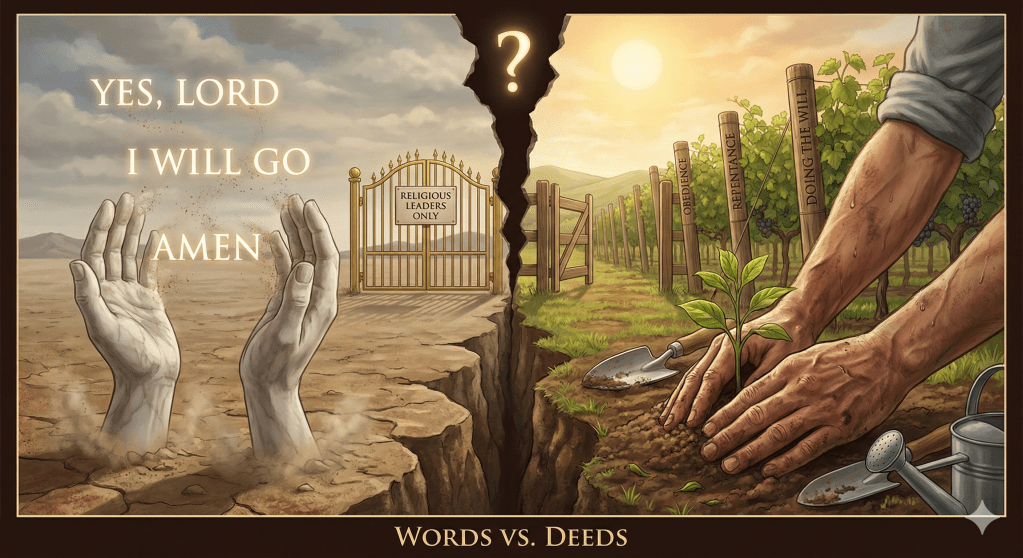
To expose this deeper issue, Jesus told three parables in Matthew 21. The first is the story of the two sons (Matt. 21:28–32).
A father asks both his sons—same status, same request—to go and work in the vineyard.
The first son says NO.
Culturally rude. Spiritually unacceptable.
But later, he changes his mind and goes to work.
The second son gives a polite, respectful answer:
“I will go, sir.”
But he never goes.
Jesus asks a simple question:
Who did the will of the father?
The first son was a loud failure—he openly said no.
The second son was a quiet failure—he said all the right things but never acted.
Verbal obedience without action is disobedience.
Profession without obedience is dangerous.
The tragedy is this: the religious leaders mastered religious language. They sang it, prayed it, taught it, and enforced it. But when God asked, “Will you go and work in my vineyard?” they never went.
Today’s church must pause here. Are our verbal affirmations—songs, prayers, public confessions, and praise—quietly replacing practical obedience? Do we assume that saying “Yes, Lord” is the same as doing His will?
Jesus then draws a sharp contrast.
The tax collectors and prostitutes—those who openly said NO to God—repented and obeyed when John preached.
“For John came to you in the way of righteousness, and you did not believe him, but the tax collectors and the prostitutes believed him, and even after you saw it you did not change your minds and believe him.” (v.32)
Past failures should never prevent present obedience.
The Kingdom belongs to the repentant, not the respectable.
The Samaritan woman, Matthew the tax collector, Zacchaeus—none had perfect beginnings, but all responded with obedience and became part of the Kingdom.
So, who really does the will of the Father?
Both sons failed—but one repented and obeyed.
Not perfect obedience, but real obedience.
Yet the final and perfect answer is the Son who told the story.
Jesus is the only Son who always did the Father’s will.
He said, “My food is to do the will of Him who sent me.”
As we begin a new year, let Jesus be our example.
Not loud words without action.
Not polite answers without obedience.
May our “Yes, Lord” move beyond our lips to our lives.
And may we be found not just speaking the will of the Father—but doing it.


Leave a comment