“There’s a popular saying: ‘When you have someone to love, some work to do, and something to look forward to, then you will have happiness.’
That sounds convincing.
But is it really true?
Happiness is the pursuit of every human being. The pursuit continues—but are we really happy? Do we truly have joy?
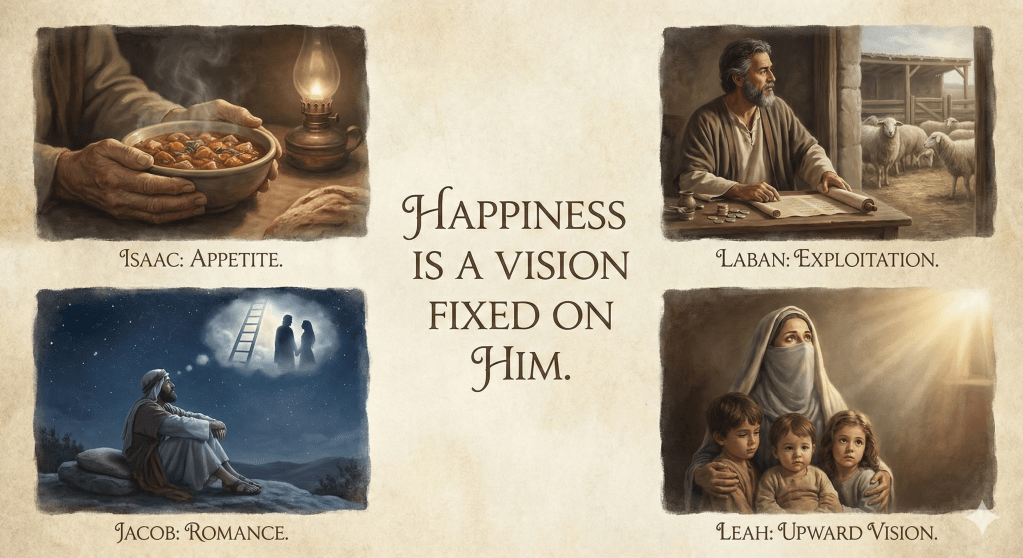
In Genesis chapters 26–29, we meet different characters, all in pursuit of happiness. Each chose a different path, and each reveals where that path finally leads.
Isaac: Happiness through Appetite
Isaac was once a man of meditation (Gen. 24:63) and prayer (Gen. 25:21). But in his old age, when his eyesight was dim and his body weak, his desire narrowed down to one thing—a well-prepared, savoury venison curry. His final wish was good food.
Appetite and taste, for some, become the definition of happiness. Who enjoyed food more than King Solomon? Yet his conclusion is sobering:
“All human toil is for the mouth, yet the appetite is not satisfied” (Eccl. 6:7). Enjoying good food is not sin—but it cannot offer lasting happiness.
Jacob: Happiness through Romance and Relationships
Jacob, shaped by family manipulation and involved in deceiving his father, flees from Esau’s fury. A home-grown man now runs nearly 800 kilometers—possibly at the age of 77. With a stone for a pillow, he sleeps in fear and loneliness.
When he meets Rachel, Jacob believes happiness has arrived. Romantic love, emotional security, companionship—everything seems to converge. He works seven years, and Scripture says they seemed like a few days because of his love for her.
But then comes the morning shock: “There was Leah.”
The deception Jacob once practiced is now returned to him. Romance and relationships, though beautiful gifts, could not guarantee happiness.
Laban: Happiness through Exploitation
Laban found happiness in control and exploitation. Discovering Jacob’s ability and diligence, he trapped him—first with Leah, then with Rachel, then with fourteen years of labour. For him, happiness was always on the other side of one more clever deal.
Exploiting others for personal gain may bring temporary satisfaction, but it reveals a deeply broken value system. It is happiness built at another’s expense.
Leah: Happiness through Acceptance
Leah’s story is the most painful. Genesis 29:17 describes her eyes as “weak” or “soft”—a phrase scholars debate. Many believe she suffered from an eye condition, making her less attractive than Rachel. Comparison may have shaped her from childhood.
Jacob loved Rachel more. The Lord saw that Leah was unloved and opened her womb. Listen carefully to the names she gave her sons:
- Reuben – “Now my husband will love me.”
- Simeon – “The Lord has heard that I am hated.”
- Levi – “Now my husband will be attached to me.”
Leah believed acceptance—from her husband—would bring happiness. She lived with an inward focus, hoping each birth would fix her pain.
The Turning Point: A Change of Vision
Then something shifts.
When the fourth son is born, she names him Judah:
“This time I will praise the LORD.”
Her vision turns—from herself to God. Scripture quietly adds, “Then she ceased bearing.” Not because her circumstances were perfect, but because her heart had found rest.
Asaph describes the same struggle in Psalm 73. He knew the right belief—“Truly God is good to Israel.” But he stumbled when his vision shifted to the prosperity of the wicked. When vision changes, values change. And when values change, happiness collapses. The sanctuary did not change his circumstances; it changed his vision. Asaph recovered when he entered God’s sanctuary and saw life from God’s perspective.
Conclusion: Where Is Your Vision Fixed?
Isaac looked to appetite.
Jacob looked to romance and relationships.
Laban looked to exploitation.
Leah looked inward—until she looked upward.
Happiness is not found in food, success, approval, or even love—though all are gifts. True happiness begins when our vision rests on God. When our eyes are fixed on Him, our values realign, and joy follows.
Leah’s God-centered praise gave birth to Judah. From Judah came David. From David came Christ. What began as rejection was quietly woven into redemption. For those who love God and fix their vision on Him, even broken stories are gathered and worked together for good (Rom. 8:28).
True happiness is not found when life finally goes our way—but when our vision finally looks His way.

 Ennathinks
Leave a comment