Have you ever attended a wedding engagement at 12 a.m. (midnight)? I have.
A journey that was supposed to end by 4 p.m. was delayed because of a faulty bus, and we finally reached at midnight. We burst firecrackers to alert the bride’s family. They woke up, gathered themselves, and slowly the function began. The person reading the Isaac–Rebekah passage didn’t know where to stop, and our stomachs were crying louder than the firecrackers! Still fresh in my memory.
A first-century Jewish wedding had three stages. Kiddushin—where the groom gives a small piece of gold and sets the bride apart. A written contract (Ketubah) follows, outlining responsibilities and privileges. Then the groom leaves and returns later—sometimes even after a year—with his friends. The bride is received, lifted (Nissuin), and the celebration begins.
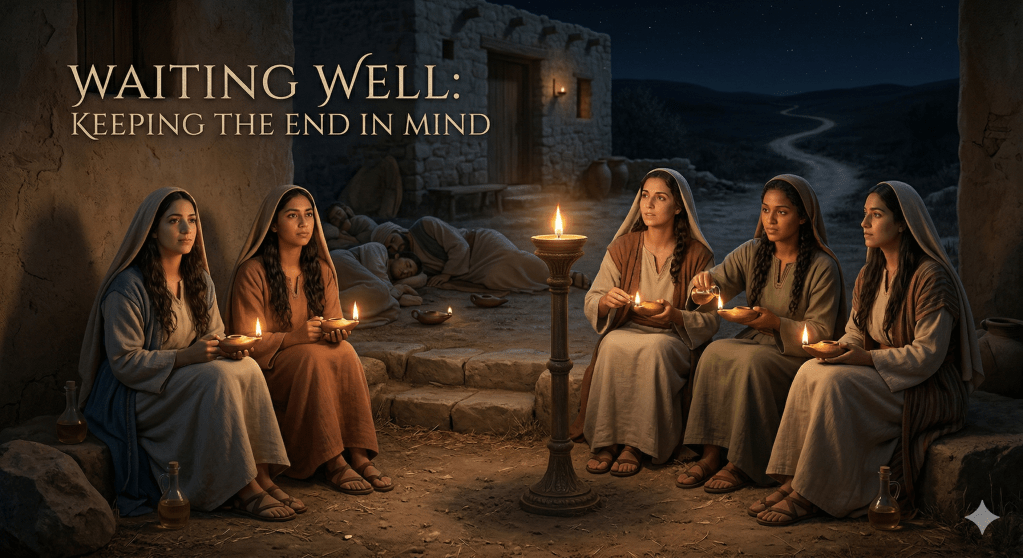
In the Olivet Discourse, where Jesus teaches how to live while waiting for His return, He tells a parable (Mt. 25:1–13). The setting is after the formal agreement—everyone is waiting for the groom. Ten bridesmaids are chosen to welcome him. All ten accepted the role. All ten began well. But as the story ends, five of them miss the very purpose they were called for.
This is not a story between believers and unbelievers. This is within the community.
Keep the End in Mind
As a community, we are given a calling. But we must be faithful not just in receiving it—but in completing it.
All ten bridesmaids had lamps. All ten had a role. But five missed the banquet.
If we forget the end, the entire process becomes meaningless.
Day-to-day activity without the end in view leads to spiritual emptiness.
Keep the Delay in Mind
All the parables in the Olivet discourse carry this theme—the groom is delayed.
Peter addresses this in 2 Peter 3:3–4. Scoffers will come asking, “Where is His coming?” We see this today—in conversations, in media, even in subtle thoughts.
But the delay is not accidental. It is part of God’s plan.
Peter explains: in God’s economy, one day is like a thousand years. so for Him just two days are over! What feels long to us is not delay to Him. He is patient, giving time for many to come into His Kingdom.
If we misunderstand the delay, we will mis-live the present.
Keep the Routine in Mind
In the parable, when the groom delayed, all ten slept.
Not just the foolish—the wise too.
Waiting does not mean abandoning daily life. It means living it faithfully.
As William Barclay said,
“When Jesus Christ comes, He should find me doing my daily work quietly, efficiently and calmly.”
The problem is not routine. The problem is forgetting the reason behind the routine.
Keep Listening for the Cry
At midnight, the cry was heard: “Here is the bridegroom!”
They were awakened by the sound.
Paul echoes this in 1 Thessalonians 4:16—the Lord will come with a shout.
We must live in such a way that we are sensitive to that sound.
Like a mother who wakes up at the faint cry of her baby—even in deep sleep—there must be an inner alertness.
Keep the Oil in Mind
This is the crux of the parable.
The issue was not the lamp—it was the oil.
The five were not rejected because they didn’t begin—but because they were not prepared.
- No borrowing possible
- No sharing possible
- No last-minute correction
David Pawson rightly says:
“You cannot borrow someone else’s spirituality.”
This is deeply personal.
Association with the community is not enough.
Activity in the ministry is not enough.
There must be an inner life—sustained, prepared, and real.
Keep Burning and Shining
We are called to shine as stars in a crooked and perverse generation (Phil. 2:15).
What sustains this shining?
Paul gives the answer: “holding fast to the word of life.”
Peter, after witnessing the transfiguration, says something striking. Even after such an experience, he points to something more sure—the prophetic word.
“You will do well to pay attention to it, as to a lamp shining in a dark place…” (2 Pet. 1:19)
The Word keeps the lamp burning.
Conclusion
All ten started.
Only five finished.
The difference was not opportunity.
The difference was not calling.
The difference was preparedness.
The delay is real.
The routine is normal.
Sleep will come.
But the cry will also come.
And when that moment arrives—there is no time to prepare.
So let us live keeping the end in mind,
walking through the delay,
faithful in the routine,
listening for His voice,
and keeping our lamps burning.
Because when the door is shut—
it is shut.
 Ennathinks
Leave a comment